

Auschwitz Memorial — Teacher & Student Resource Pack


A free resource for teachers preparing a school visit to the Auschwitz-Birkenau Memorial and Museum, or teaching the history of Auschwitz in the classroom. May be reproduced for educational use.
Contents (outline)
- Why preparation matters
- Historical context: what students should know before the visit
- Practical rules for school groups
- Discussion prompts — before the visit
- Discussion prompts — after the visit
- Glossary of key terms
- Recommended sources for teachers and students
1. Why Preparation Matters
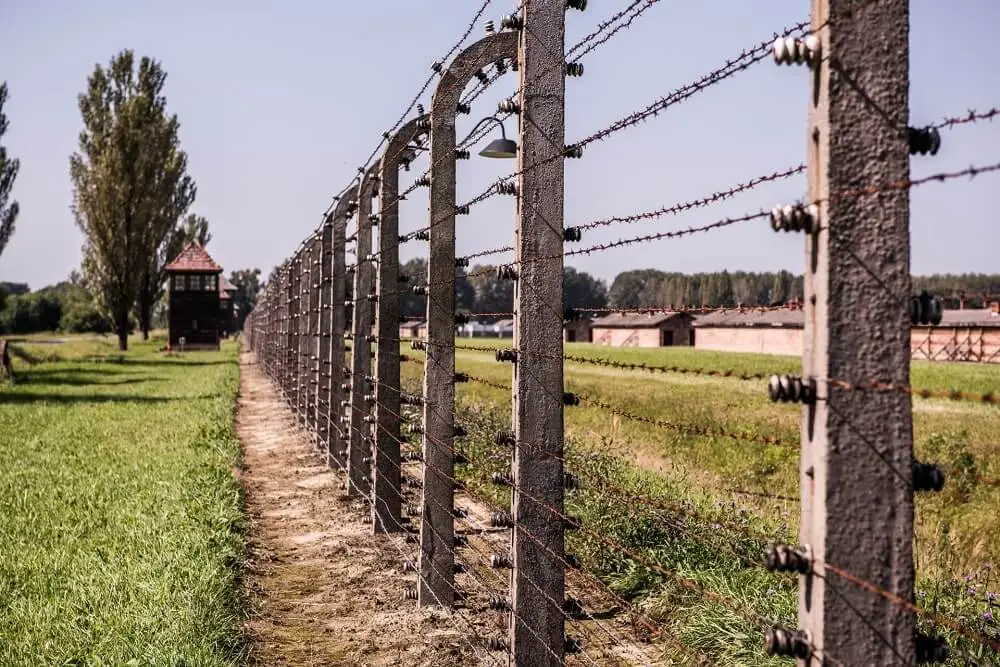
Auschwitz-Birkenau is not a museum in the ordinary sense. It is an authentic site — a cemetery and a place of remembrance — where around 1.1 million people were murdered. Research and the Memorial’s own educators agree on one point: students who arrive prepared take incomparably more from the visit than those who arrive knowing only the name. Preparation also protects students emotionally. The exhibitions confront visitors with evidence of mass murder, and young people should not encounter this material for the first time without context.
This pack gives you the essentials: the historical facts every student should know beforehand, the practical rules that govern school visits, structured discussion prompts, and a glossary of terms your students will hear on site.
2. Historical Context: What Students Should Know Before the Visit
The following points are drawn from the Auschwitz-Birkenau State Museum (auschwitz.org) and the United States Holocaust Memorial Museum (ushmm.org). Each makes a suitable starting point for a pre-visit lesson.
- Auschwitz was established by Nazi Germany in 1940 on the outskirts of Oświęcim, a Polish town annexed to the Third Reich. It was initially a concentration camp for Polish prisoners.
- The first transport arrived on 14 June 1940 — 728 Polish political prisoners from the prison in Tarnów.
- From 1942, Auschwitz became the largest of the Nazi extermination centres, where the so-called “final solution to the Jewish question” — the planned murder of the Jews of Europe — was carried out.
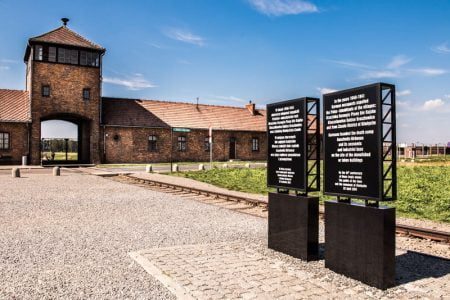
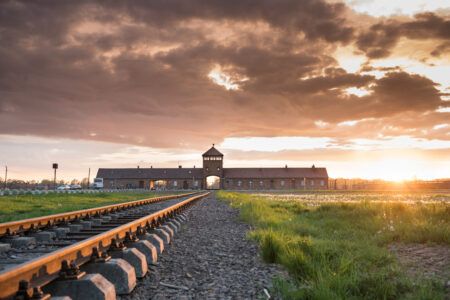
- The complex had more than one part. Auschwitz I was the original camp; Auschwitz II-Birkenau, 3.5 km away, became the principal site of extermination. Students will visit both.
- Around 1.1 million people perished at Auschwitz, according to the Memorial’s research: approximately 1 million Jews, some 70,000 Poles, about 21,000 Roma and Sinti, around 15,000 Soviet prisoners of war, and some 12,000 prisoners of other backgrounds.
- The camp was liberated by Soviet forces on 27 January 1945. About 7,000 prisoners, most critically ill, were found alive. This date is now International Holocaust Remembrance Day.
- The Memorial was created by an act of the Polish parliament on 2 July 1947, at the initiative of survivors, to preserve the site and the memory of the victims.
For deeper preparation, direct students to the history section of auschwitz.org and to the USHMM’s Holocaust Encyclopedia (encyclopedia.ushmm.org), which offers accessible, scholarly articles on Auschwitz, the Holocaust and related topics in plain English.
3. Practical Rules for School Groups
These rules come from the Memorial itself; checking the current versions at visit.auschwitz.org shortly before your visit is part of good planning.
- Recommended minimum age: 14. The Museum states that visits by children under the age of 14 are not recommended. Plan school visits for students aged 14 and over.
- Personalised entry passes are compulsory and available only online at visit.auschwitz.org — none are sold at the entrance. Every participant, including group members, must carry their personalised pass and photo ID.
- Book well in advance. Demand is high, particularly in autumn; reserve group passes as early as your school calendar allows.
- Groups visit with a Museum educator. Guided study visits are led by the Memorial’s trained guide-educators; a fee applies for the educator, although entry to the grounds itself is free.
- Allow at least 3.5 hours on site. The Museum recommends a minimum of about 90 minutes for each part of the Memorial. A free shuttle bus connects Auschwitz I and Birkenau.
- Bag limit: 35 × 25 × 15 cm. Larger bags must stay on the coach.
- Conduct and dress. Visitors are asked to behave with due solemnity and respect, and to dress in a manner befitting the character of the site. Brief students explicitly: quiet voices, no eating on the grounds, no casual selfies, and full attention to the educator’s instructions.
- Prepare for weather and walking. Birkenau is a vast, exposed site; students need sturdy shoes and weather-appropriate clothing in every season.
A note on wellbeing: agree in advance on a quiet signal a student can use if they need to step aside, and identify which accompanying adult will stay with them. Some students are affected in ways neither they nor you can predict.
4. Discussion Prompts — Before the Visit
Use one lesson before departure. Suggested prompts:
- What do you already know — or think you know — about Auschwitz? Where does that knowledge come from?
- Why do historians insist on precision with numbers and terms when discussing the Holocaust? What harm does exaggeration or minimisation do?
- Auschwitz began as a camp for Polish political prisoners and became a centre of the murder of European Jews. What does this evolution tell us about how the Nazi system developed?
- We will be walking through a cemetery without graves. How should that shape the way we behave there?
- What is the difference between learning history from a textbook and standing in the place where it happened? What do you expect to feel?
- Whose voices should we listen to when we study this history — and why do survivor testimonies matter so much?
5. Discussion Prompts — After the Visit
Schedule this within a few days of returning, while impressions are fresh.
- Which single object, room or place stayed with you most strongly — and why?
- Did anything you saw differ from what you expected? What does that gap tell you about how the Holocaust is portrayed in films and popular culture?
- The perpetrators were ordinary people — clerks, drivers, doctors, guards. What conditions made their participation possible?
- What choices did prisoners, bystanders and rescuers actually have? Discuss the danger of judging from hindsight.
- The Memorial exists “so that it never happens again.” Where in today’s world do you see warning signs — propaganda, dehumanising language, exclusion — that this history teaches us to recognise?
- What responsibility, if any, do you now feel as a witness of the site? How will you speak about Auschwitz to someone who has never been?
6. Glossary of Key Terms
| Term | Meaning |
|---|---|
| Holocaust / Shoah | The systematic, state-organised persecution and murder of approximately six million Jews by Nazi Germany and its collaborators, 1933–1945. Shoah is the Hebrew term. |
| Auschwitz I | The original camp at Oświęcim, established in 1940; today it houses the main exhibitions. |
| Auschwitz II-Birkenau | The largest part of the complex, 3.5 km from Auschwitz I; the principal site of extermination. |
| Concentration camp | A camp for imprisonment, forced labour and terror, without trial. |
| Extermination camp | A site built or adapted for systematic mass murder. Auschwitz functioned as both. |
| “Final solution” | The Nazi euphemism for the planned murder of the Jews of Europe. |
| Deportation | The forced transport of people, most in freight wagons, to ghettos and camps. |
| Selection | The process on the arrival ramp in which SS personnel chose who would be registered for labour and who would be murdered immediately. |
| Ghetto | An enclosed district in which Jews were forcibly confined before deportation. |
| Antisemitism | Hostility towards or prejudice against Jews — the ideology at the root of the Holocaust. |
| Roma and Sinti | Ethnic groups targeted for persecution and murder by the Nazi regime; about 21,000 perished at Auschwitz. |
| Liberation | The arrival of Soviet forces at Auschwitz on 27 January 1945, now marked as International Holocaust Remembrance Day. |
7. Recommended Sources for Teachers and Students
Use primary, scholarly sources. The three institutions below are the standard references:
- Auschwitz-Birkenau State Museum — auschwitz.org (history, victim data, visiting rules, online lessons) and visit.auschwitz.org (reservations for school groups).
- United States Holocaust Memorial Museum (USHMM) — ushmm.org, and in particular the Holocaust Encyclopedia at encyclopedia.ushmm.org, with classroom-ready articles, photographs, maps and survivor testimony.
- Yad Vashem — The World Holocaust Remembrance Center — yadvashem.org, including its educational materials, the Central Database of Shoah Victims’ Names, and teaching units designed for secondary schools.
We encourage teachers to build lessons directly from these institutions’ materials rather than from summaries — including this one.
This resource pack was prepared by the team at MrShuttle, a Krakow-based operator of study visits to the Memorial. Practical travel information for visit planning is available in our companion Auschwitz-Birkenau Visitor Guide. Facts verified against auschwitz.org, July 2026. May be copied and distributed for educational purposes.